When I started working on Lakini's Woods in late 2014, I wrote a game design document, that contained a basic set of features and core game play mechanics. Up until today I never updated this document and with everything that I have learned until this point it is of course grocely outdated. During the first couple of weeks in 2017 I felt that I had been going around in circles and one of those reasons was, that I had been straying from the original game design way too far. I'm currently reading up on publications, studies and compendiums on game design and game mechanics. I found a collection of amazing reading material:
"Gameplay and Game Mechanics Design: A Key To Quality in Video Games" by Carlo Fabricatore
"Gamedesign: Theory and Practice" Richard Rouse III & Steve Ogden
"Level-Up" by Scott Rogers
At the same time I started playing around with the early 80s generation of NES and SNES video games again, while breaking down their core mechanics and analyzing the overall level structure.
I found games like "Super Mario Bros.", "Tetris" and the very first "Zelda" incredibly enlightening, as these games have a very strict and coherent rule set. A game called "Terranigma" which was released in the late 90s for the SNES caught my attention again. I was stunned by the sheer quality of game design, a beautiful battle system and a clean, solid code that delivers a stable and glitch free game experience from start to finish.
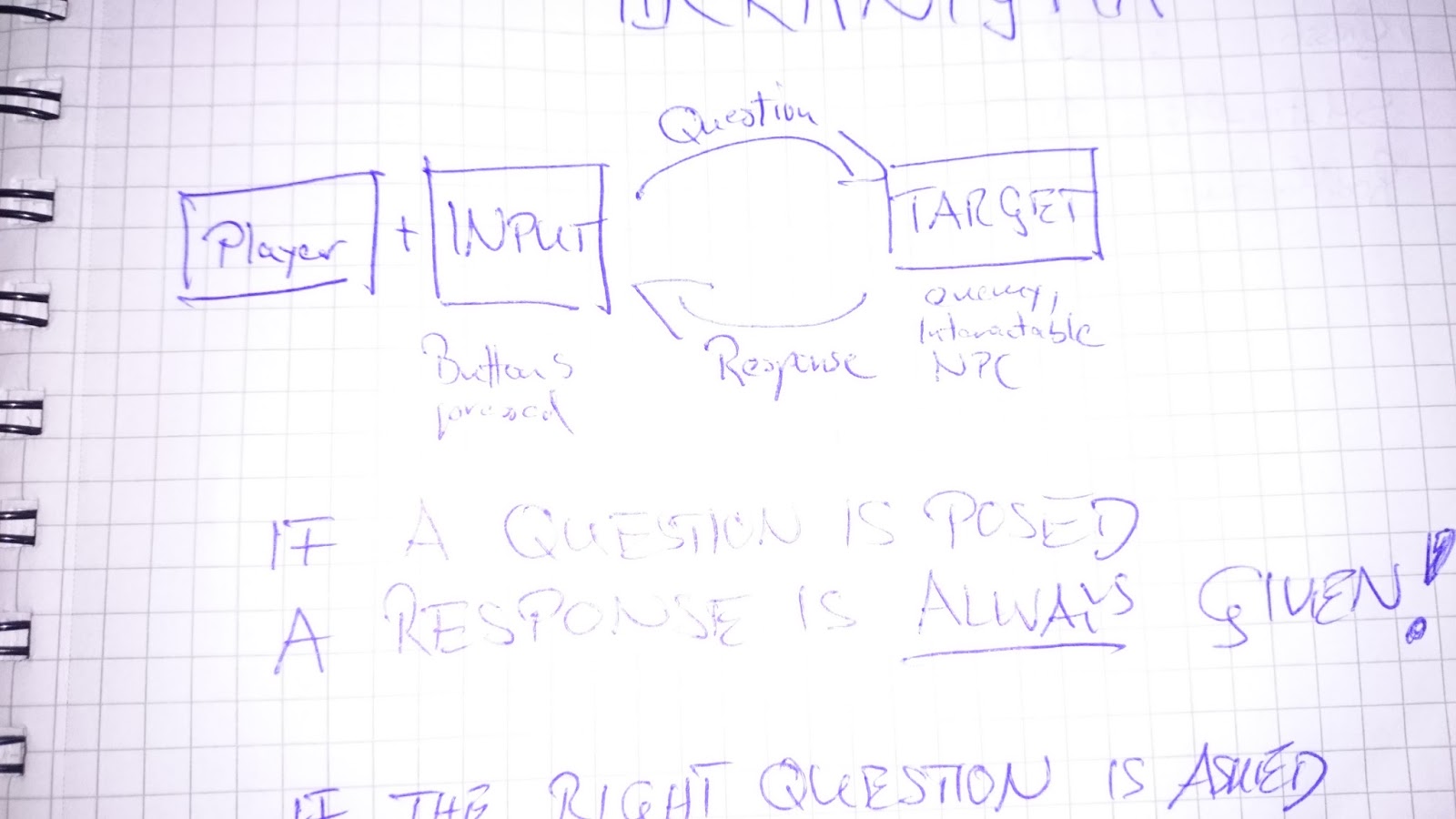
Especially in the case of Terranigma I discovered a major feature, which turns out to be a hallmark of game design quality across all genres: A clear Question /Response Loop:
Every time a player interacts with the game world he "poses a question" for which he expects a definitive answer. Let's say our player character hits the wall of a dungeon with his sword: In this scenario there are several possible outcomes:
1.) The sword collides with the wall (experienced through an animation and a SFX), but nothing else happens
2.) The sword collides with the wall and the weapon breaks.
3.) The sword hits the wall and a hollow SFX is played, indicating that the wall is fragile and can be torn down
4.) The sword goes through the wall, without any consequences
5.) The sword goes through the wall, hitting enemies on the other side of it
6.) The sword hits the wall, triggering a hidden door mechanism on the other end of the room
If every time the player attacks the wall, he receives a different response scenario, without an apparent reason, then he can never confidently trust the rule set of the game. Terranigma does this flawlessly on multiple levels and it raises the overall quality of the game immensely.
To compare: "Secret of Mana" or better known as "Seiken Densetsu" for the SNES had a much less stable Question/Response Loop. Even though the game is great and I love playing it, I find that the code is much weaker and that glitches happen all throughout the game. If my player token is hit by an enemy in this game, based on the location of both hit boxes there is at times great uncertainty of whether or not my player token will receive damage. This creates frustrating experiences ... especially in "close call" situations where you have to rely on the position of your character and the fact that he is outside of the enemy's damage range.
I realize that I should have started out with all of these considerations 3 years ago. But at the time I had no idea how to write code or work with Unreal Engine 4. At least now I know how to do all of these things.
Because I didn't know any better I initially contracted parts of the game, that I wanted to have finished (models, VO) right at the beginning to other crew members. And the people that worked for me provided me with great results, and all of their hard work will be a part of the final project ...... but it's slowly sinking in, that my initial design contained some major errors that I'm just now finding out about. And I shouldn't have involved other people without re-thinking my basic concept.
I was wrong about many things .... ironically I was right about all the things that other designers warned me about in the beginning. For example the dharmapala system can basically remain just as it is, without losing any FPS and the overall environment design including the selfbuilding world can also be incorporated. I can even keep the code just as it is, without having to make any changes to it.
But there will be no items, there will be no weapons apart from the elementals and there will be a much cleaner interaction system that eliminates all possibilities for collision errors. I will keep the "Reichsmark" currency system though. They simply look beautiful when they are placed inside the game world and they correspond well with the buildings and the soldiers chasing Jonah.
In order to create a decent and coherent design I will need to read up on a ton of books and papers first, and for some time I will need to get back to the first generation of games and take them apart piece by piece, to better understand their overall structure and mechanics. I don't want to make the same mistake twice.